

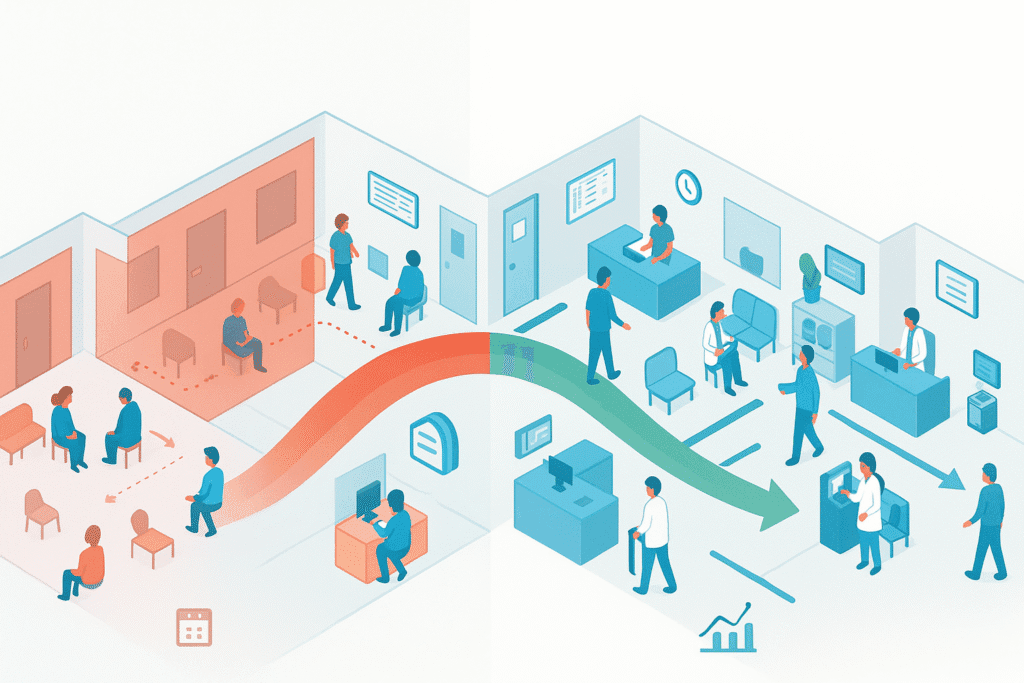
Most healthcare facilities operate at only 40-60% space utilization, well below the industry-standard 70% target. This inefficiency costs millions in wasted real estate expenses and missed patient appointments annually. With healthcare construction costs surging 40% since 2020 to $700-730 per square foot, optimizing healthcare facility space utilization has become critical for financial success.
What is Healthcare Facility Space Utilization?
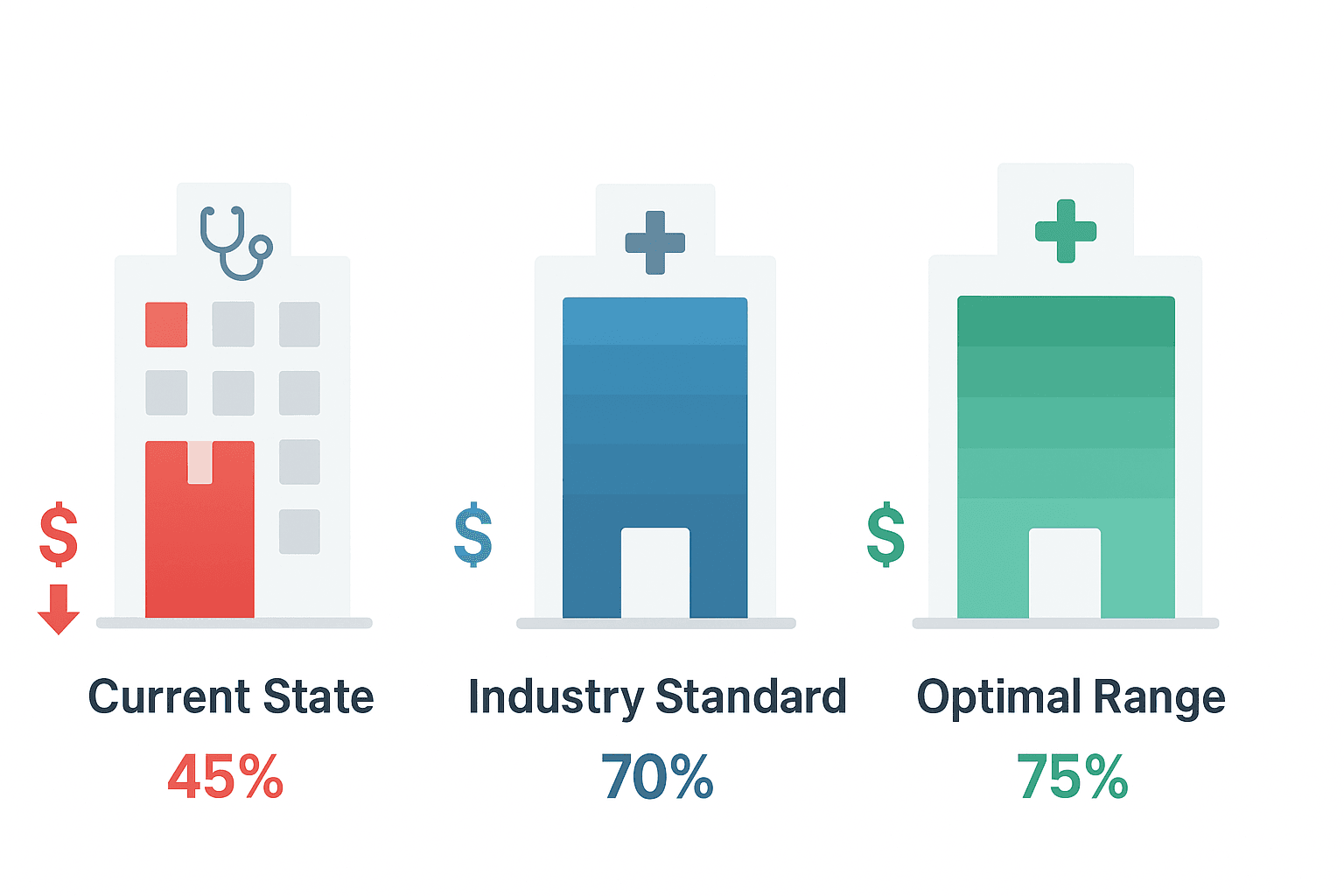
Healthcare facility space utilization measures how effectively your available space generates revenue and serves patients. Unlike simple occupancy rates, efficient healthcare space utilization considers occupancy frequency, revenue productivity, and adaptability for multiple purposes.
The fundamental principle centers on maximizing patient care capacity while maintaining quality standards. Healthcare space management follows a tiered approach: exam rooms should target 70% utilization, procedure rooms can achieve 80%, and any clinical space beyond 85% risks quality issues and staff burnout.
Critical Rule: Never exceed 85% utilization in any clinical space; quality and safety require buffer capacity.
How Do You Calculate Healthcare Facility Space Utilization?
Calculating healthcare facility space utilization uses this basic formula: Utilization Rate equals actual output divided by potential maximum capacity, multiplied by 100%. For exam rooms, multiply patient visits by average room time to get total minutes utilized, then divide by total available minutes across all rooms during operating hours.
For example, 5 exam rooms operating 8 hours daily (2,400 total minutes) with 30 patient visits averaging 20 minutes each (600 utilized minutes) yields 25% utilization, which is significantly below the 70% target.
| Space Type | Target Utilization | Key Metric | Industry Benchmark |
| Exam Rooms | 70% | Minutes utilized ÷ Available minutes | 70-80% optimal range |
| Procedure Rooms | 80% | Scheduled procedures ÷ Available slots | 75-85% optimal range |
| Operating Rooms | 75-80% | Block utilization rate | >75% good performance |
| Patient Beds | 80-85% | Occupancy rate | 80-85% optimal range |
Track revenue per square foot, patient visits per exam room annually, peak utilization times, and equipment utilization rates.
Healthcare Facility Space Management
Effective healthcare space management combines five fundamental elements. Space allocation and design forms your foundation, involving how you assign and configure physical spaces. Patient flow optimization minimizes unnecessary movement through strategic layout.
Scheduling and workflow optimization directly impacts space utilization through dynamic scheduling systems that optimize appointment timing. Technology infrastructure ensures spaces can support current and future medical equipment needs. Performance monitoring ensures your space management strategies deliver results through targeted analytics and ROI calculations.
Efficiency Tip: With block scheduling you can group similar appointment types for maximum turnover efficiency.
How to Identify and Implement Healthcare Facility Space Optimization Opportunities
To start with, you should gather about three months of healthcare facility space utilization data including appointment scheduling, actual usage times, and revenue by space. Direct observation reveals patient flow bottlenecks, staff movement inefficiencies, and equipment utilization gaps that data alone misses.
Using the info gathered, you can initially focus on quick wins like adjusting appointment templates based on actual procedure times, implementing flexible room assignments instead of provider-dedicated spaces, and converting underutilized administrative areas to clinical use.
Quick Win: Many practices increase capacity by 25% through space reconfiguration rather than expensive expansion.
Implementation success of your space optimization strategies would require staff buy-in and compliance with CMS Conditions of Participation, Joint Commission standards, and state licensing requirements. FGI Guidelines (which are adopted by all 50 states) establish minimum space requirements including 80 square feet for standard exam rooms and 250 square feet for patient rooms. Space utilization must also protect patient privacy through HIPAA-compliant physical safeguards, acoustic privacy, and access controls.
Technology Solutions for Healthcare Space Optimization
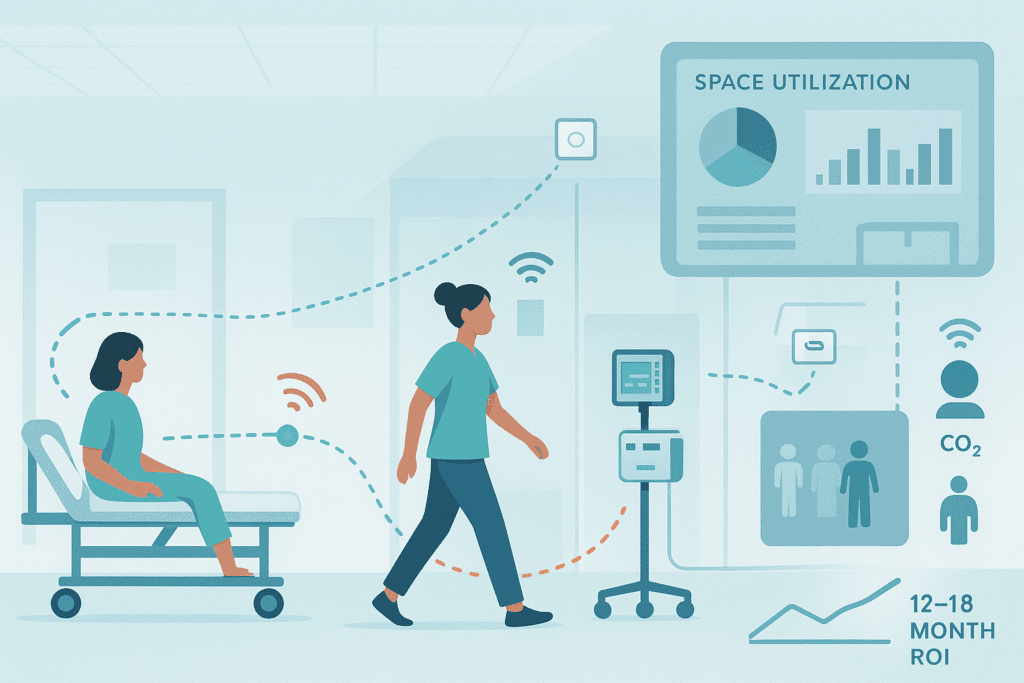
Technology integrations are helpful and increasingly crucial in healthcare facility space optimization. Real-Time Location Systems serve as “indoor GPS” delivering three primary benefits: instantaneous equipment location, patient flow monitoring revealing actual journey times, and staff productivity analyses that identify movement inefficiencies.
Integrated Workplace Management Systems combine facilities management, space planning, and cost analysis. Occupancy sensors provide utilization data without major infrastructure investment through passive infrared detection, CO2 monitoring, and thermal counting.
ROI Timeline: Most facilities achieve payback on space management technology within 12-18 months.
Maximizing Your Healthcare Facility’s Space Utilization
Healthcare facility space utilization represents a significant untapped opportunity for improving practice financial performance. Fortunately, facility space optimization doesn’t require massive capital investment; the most impactful improvements come from better scheduling, workflow optimization, and data-driven decision making. Take a systematic approach starting with baseline measurements, focusing on quick wins while building toward larger strategic improvements.
Competitive Advantage: Facilities mastering space utilization gain competitive advantages in adaptability, efficiency, and acquisition attractiveness.
With SovDoc’s healthcare M&A specialists, you can use efficient space utilization as a strategic asset that showcases your practice’s management efficiency and enhances your growth potential. Contact SovDoc today for personalized consultation that helps you discover how your healthcare facility space utilization improvements can accelerate your practice’s strategic goals and enhance your position in the healthcare M&A marketplace.