


A statistic every practice owner should know highlights a critical issue. While 67% of physicians are interested in leadership, only 18% receive formal business training in medical school. This creates a leadership gap that 62% of healthcare organizations struggle to fill. For a practice owner, this gap is not an abstract problem. It is a direct risk to your operational stability and a potential drag on your practice’s valuation.
Strong physician leadership is not an innate trait; it is a strategic asset built through intentional development. Whether you are preparing your practice for a sale, navigating a merger, or aiming to secure a key role post-acquisition, understanding what makes a physician leader effective is critical. This guide breaks down what you need to know about leadership development programs and why they are a crucial investment for your practice’s future.
How Does Strong Leadership Increase Your Practice’s Value?
You have spent years mastering the clinical skills that built your practice’s reputation. However, the competencies required to run a successful business, let alone navigate the complexities of a merger or acquisition, are entirely different. The precision needed for diagnosis does not automatically translate to managing a budget. Excellent patient care skills do not guarantee you can lead a team through the uncertainty of an M&A transition.
Leadership development programs are designed to bridge this exact gap. They equip physicians with the business acumen and strategic foresight to not only run a practice but to make it a more attractive asset to potential buyers. Acquirers look for well-led organizations because they integrate more smoothly, retain key talent, and maintain performance during change. Investing in leadership is investing in a higher valuation and a smoother transition.
The Bottom Line: Acquirers don’t just buy practices; they invest in well-led organizations that promise smooth integration, better talent retention, and stable performance through change.
What Are the Core Elements of Effective Leadership?
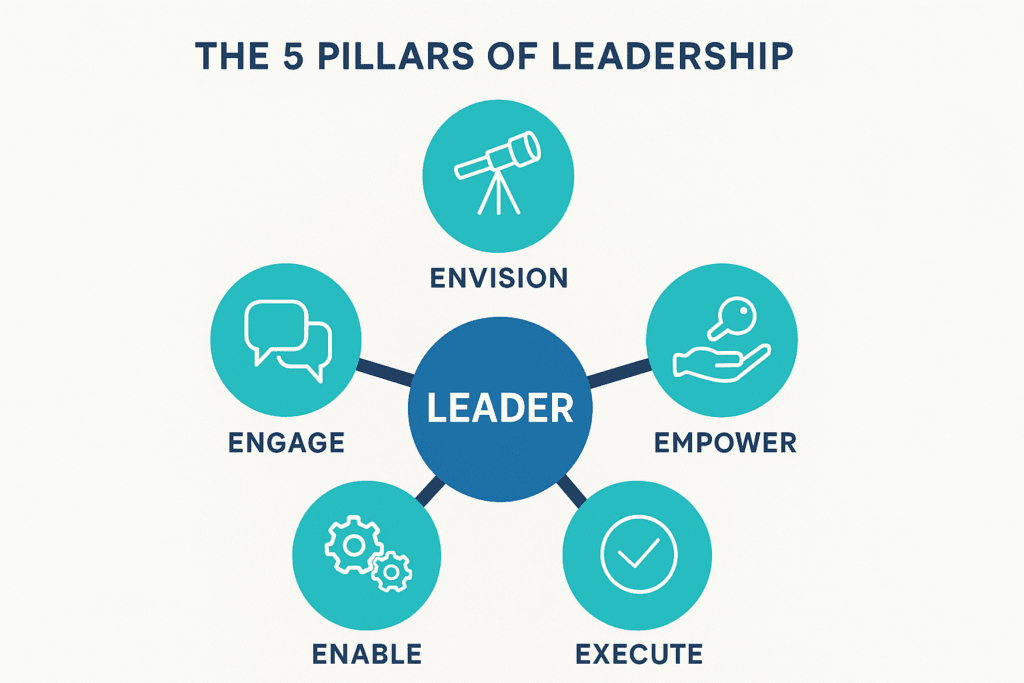
Effective leadership is defined by five core actions. A strong leader must envision a clear future for the practice, articulating where the combined entity is headed during an M&A process. They must engage their team by communicating that vision to align everyone and reduce anxiety.
From there, leaders empower their key physicians and staff, giving them the authority to make decisions and maintain a sense of autonomy within a new structure. They also enable success by removing obstacles, whether it is streamlining a new billing process or securing resources from an acquiring entity. Finally, and most critically, they execute. This is the ability to deliver results and successfully integrate operations while protecting patient care quality, turning a strategic plan into a tangible reality.
What Competencies Should Your Leadership Team Have?
While clinical expertise is a given, acquirers and health systems look for specific business and interpersonal competencies in physician leaders. Developing these skills within your practice demonstrates stability and readiness for growth.
M&A Insight: During due diligence, demonstrating strong business acumen is as important as clinical excellence. It proves your practice is a well-managed asset, not just a collection of providers.
| Leadership Competency | Why It Matters for Practice Owners (Especially in M&A) |
| Technical & Business Skills | Understanding financial statements, revenue cycle management, and HR fundamentals is non-negotiable. During due diligence, your ability to speak this language proves your practice is a well-managed business. |
| Healthcare Industry Knowledge | Buyers want leaders who understand consolidation trends, value-based care, and regulatory shifts. This shows you are prepared for the future, not just managing the present. |
| Emotional Intelligence (EQ) | M&A creates stress. Leaders with high EQ can manage team anxiety, navigate difficult conversations with empathy, and maintain morale through periods of uncertainty. |
| Communication & Influence | Effective leaders persuade stakeholders and negotiate constructively. This is vital when communicating changes to staff or aligning with the goals of a new parent organization. |
| Vision & Strategic Thinking | This is the ability to see the big picture and anticipate challenges. During an integration, it means positioning your team for success within the larger organization. |
| Self-Awareness & Adaptability | Great leaders know their own strengths and weaknesses. This resilience and willingness to adapt is a key indicator of who will thrive in a new corporate structure. |
What Do Leadership Programs Actually Involve?

Physician leadership programs are not just academic exercises. They are structured to deliver practical skills and measurable results through a multifaceted approach.
Your journey typically begins with foundational classroom learning in finance, operations, strategic planning, and healthcare policy. This is paired with 360-degree feedback and psychometric assessments to help you build a personalized development plan based on how colleagues perceive your leadership style.
Most programs feature an action learning project, where you tackle a real organizational challenge, such as improving patient flow or reducing operational costs. This ensures the learning is immediately applied and delivers a tangible return on investment. Throughout the process, you receive executive coaching and peer mentoring to navigate specific challenges and gain insights from experienced leaders. Finally, the network you build with your cohort becomes an invaluable long-term resource. As a bonus, most accredited programs also offer 20-40 AMA PRA Category 1 Credits™, satisfying CME requirements.
What Is the Investment in a Physician Leadership Program?
Investing in leadership development involves both time and money. Costs vary significantly by program type. Regional cohort programs may cost between $4,000 and $8,000. Certificate programs from organizations like the American Association for Physician Leadership (AAPL) can range from $5,000 to $15,000. Intensive, multi-day executive programs at major universities often fall between $8,000 and $20,000. If you are part of a larger health system, these programs are often fully sponsored.
In terms of time, expect to commit 3-4 hours per week for readings and assignments, in addition to monthly or bimonthly sessions. Your action learning project will require extra time for implementation. For practice owners, it is crucial to view this not as time away from the clinic, but as time invested in building the enterprise value of your practice.
Is the Certified Physician Executive (CPE) Credential Worth It?
The Certified Physician Executive (CPE) is a well-recognized credential that signals a serious commitment to leadership. But how does it compare to a traditional MBA, and is it right for you?
CPE vs. MBA: The CPE provides targeted, healthcare-focused business training at a fraction of the cost and time commitment of a traditional MBA, making it an efficient choice for practicing physician owners.
An MBA or MHA offers broad, cross-industry recognition and a deep theoretical foundation but comes at a significant cost ($50,000-$150,000) and time commitment. The CPE, in contrast, is specifically designed for practicing physicians. It is more affordable (around $12,000), offers a flexible, self-paced format, and focuses exclusively on healthcare-specific leadership challenges.
The CPE is a powerful differentiator on a resume. Recruiters and healthcare CEOs see it as a credible mark of business and leadership proficiency. If you already have a graduate management degree, the CPE may be redundant. However, if you are a practice owner looking to strengthen your leadership credentials ahead of a transaction or qualify for a senior role in private equity-backed acquisitions without pursuing a full MBA, the CPE offers exceptional value.
Take the Next Step From Clinician to Strategic Leader
Physician leadership is not an accident. It is the result of deliberate practice and structured learning. For a practice owner, it is one of the most powerful levers you can pull to increase your practice’s value, ensure a successful M&A outcome, and secure your own professional future.
By investing in leadership development, you are building a more resilient, efficient, and valuable organization. You are preparing your practice to answer the tough questions during due diligence and to thrive through the inevitable post-acquisition changes that follow a transaction.
At SovDoc, we guide practice owners through the complexities of M&A transitions. We consistently see that practices with strong, business-savvy physician leadership achieve better valuations and smoother integrations. If you are exploring the future of your practice, contact us to discuss how leadership development fits into your broader growth strategy.